
Integrated Management Systems Built for Operational Control
Reduce duplication, tighten evidence control, and manage Quality, Safety and Environmental obligations through a single, structured management framework.
Many organisations end up managing ISO 9001, ISO 14001 and ISO 45001 across separate folders, registers, procedures and review processes.
SF Engineering restructures those requirements into a single Integrated Management System, so your business operates within a single, controlled framework rather than multiple disconnected systems.

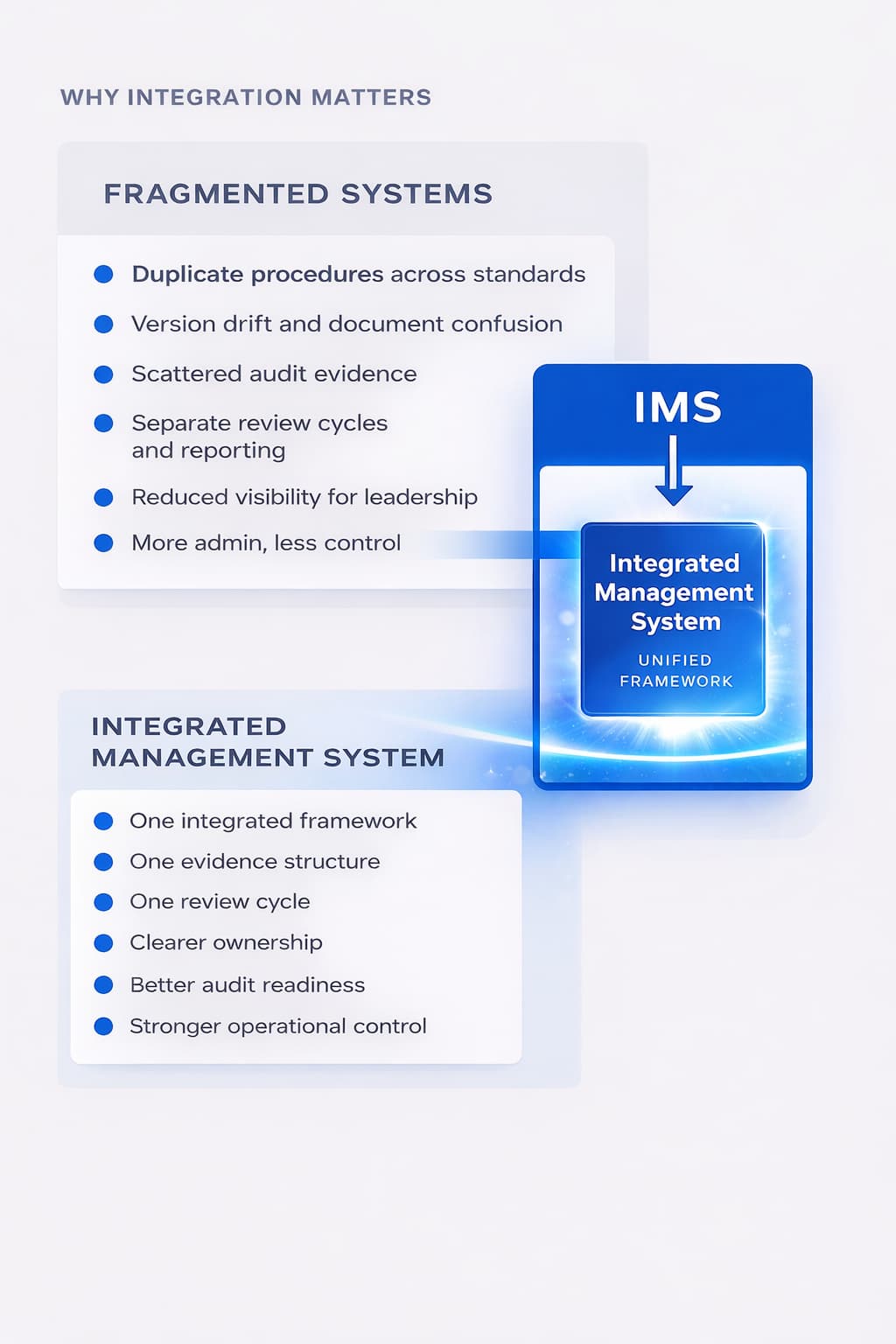
Fragmented Systems Quietly Drain Time, Control and Audit Confidence
Separate systems often look manageable at first.
Then procedures begin to overlap. Documents diverge. Teams update one register but miss another. Evidence ends up scattered across folders, departments or platforms. Internal reviews take longer than they should, and audits become more disruptive than they need to be.
What should be a structured compliance environment becomes harder to govern, maintain, and demonstrate under scrutiny. This is where an Integrated Management System starts to matter.
Need a structured certification pathway first? Explore ISO Certification, including the current April offer, or see how SF Engineering delivers projects before moving into a broader integrated system.




One Structure. One Evidence Trail. One Controlled System.
An Integrated Management System is not simply about merging documents. The real value comes from reconfiguring the system architecture so that Quality, Safety, and Environmental requirements are managed through a single aligned framework.
That means one structure for governance. One evidence trail for audits. One system your team can operate with confidence. Instead of managing three separate frameworks, your business operates within a single coherent system that meets all three standards simultaneously.
This is where compliance becomes easier to control, easier to maintain, and easier to demonstrate.
One System for Documentation, Governance and Operational Visibility
When documentation, compliance activity, audit preparation and operational data sit across separate systems, it becomes harder to maintain control and harder to see where the real gaps and opportunities are. SF Engineering helps bring those elements into one integrated framework, giving your business a clearer view of responsibilities, system performance, improvement priorities and operational risk.
What Integration Changes in Practice
When systems are brought together properly, the gains are practical straight away. Your team stops working across parallel compliance tracks and starts operating within one clearer framework.
One Master Document Control Structure
Policies, procedures, registers and records are managed through one central structure, making updates, retrieval and version control far simpler.
One Unified Risk Framework
Quality, Safety and Environmental risks sit in one view, helping teams identify overlaps, shared exposures and cross-impacts earlier.
One Corrective Action Workflow
Non-conformances, incidents and improvement actions can be tracked through one clear process instead of multiple disconnected follow-up paths.
One Internal Audit Program
Combined audits reduce disruption and give the business a more efficient way to assess system effectiveness across standards.
One Management Review Cycle
Leadership reviews performance, risks, trends, and actions through a single integrated reporting cycle rather than fragmented review structures.
Clearer Operational Visibility
Issues, trends and actions are easier to see across the organisation, giving management a stronger picture of what needs attention and where.
Reviewed for major civil project delivery support
“The team was super productive in every aspect of engineering including RFI Management and client communication.”
The reviewer also noted SF Engineering’s involvement in M12 Upgrade project completion deliverables, civil works and HSEQ requirements, with the project closed ahead of time and below budget.
M12 Upgrade project feedback
- Completion deliverables
- Civil works support
- HSEQ requirements
- RFI management
- Client communication
Systems Built for Real Operations, Not Paper Compliance
Many ISO systems look complete on paper but break down under real operational pressure.
“That usually happens when documentation is generic, evidence pathways are weak, and the system has not been built around the way the business actually works.”
SF Engineering takes a more practical approach.
We design management systems around real workflows, operational responsibilities and audit requirements, so the result is a framework your team can use, maintain and defend under scrutiny.
Where IMS Creates the Biggest Impact
Integrated systems deliver the greatest value when compliance is no longer simple, localised, or easy to manage through separate frameworks. If you want to understand how the implementation path is structured first, see How We Work.
Multi-Site Operations
For organisations working across multiple locations that need consistent governance and documentation control.
Tier 1 & Government Supply Chains
For businesses operating in tender-heavy environments where system maturity and audit readiness influence credibility.
Frequent External Audits
For organisations managing ongoing surveillance, certification or client-driven compliance reviews.
Larger Teams & Shared Ownership
For businesses where multiple people or departments touch compliance, records, risk or operational procedures.
Rapid Growth & Scaling Pressure
For organisations adding sites, projects, or staff and feeling the strain of fragmented systems.
High-Risk & Regulated Operations
For engineering, manufacturing, and contractor environments where system control matters daily.
Looking beyond a standard integrated system? Compare VANTAGE360, or request an IMS Scope Review if your next step is a practical integration discussion.
Structured Scope, Practical Delivery, Clear Investment Logic
IMS is delivered as a structured, scope-based build tailored to the complexity, maturity and operating reality of your organisation. If you want to understand the implementation path first, see How We Work.
Rather than forcing every business into the same package, we scope the engagement based on what is actually required to build a controlled, workable, integrated framework.
Common Questions About Integrated Management Systems
Straight answers to the questions businesses often ask before moving to an integrated management framework.
Bring Quality, Safety and Environment Into One Controlled System
Fragmented systems create duplication, version confusion and audit drag. SF Engineering helps you bring Quality, Safety and Environmental management into one practical, controlled framework built for real operations.
Reference Points for Integrated Management Systems
These official resources support the IMS page by grounding integrated management systems in live WHS governance, consultation, risk control, and operational system design.